Senior Product Designer · 0→1 AI healthcare experience

Designing trust
into an AI
healthcare copilot.

The challenge was never building another chatbot. It was making a contact-center agent confident enough to act on AI live, on a patient call, in a HIPAA-conscious environment, without ever looking away.
Role
Senior Product Designer
End-to-end ownership
Scope
0→1 AI scheduling
experience
Team
PM · AI Eng · Backend
Frontend · Clinical
Surface
Agent call workspace
web, 1440+
Outcome
Embedded copilot,
zero context switches
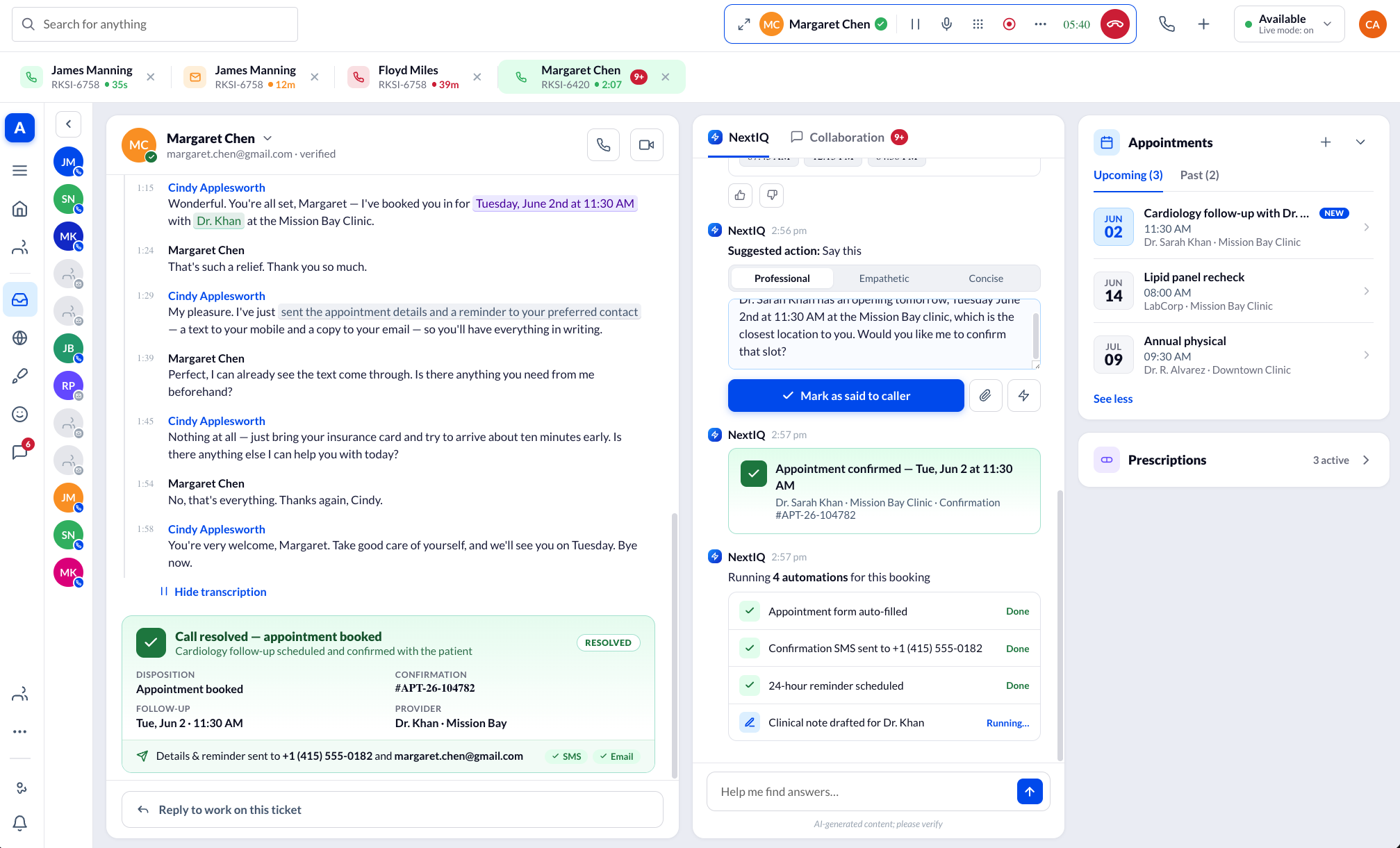
Aspen Health agent workspace with embedded AI copilot
01 / SnapshotThe work in ten seconds

An AI copilot embedded in a live call detecting intent, finding appointments, and booking them without the agent ever leaving the conversation.

The product
Aspen Health
AI-powered healthcare contact-center platform
The user
Scheduling agents
High-volume inbound calls, multi-tasking, on a clock
The job
Book a visit, live
Intent → matching slots → confirmed, mid-call
The bet
Trust over magic
AI proposes; the human always confirms
02 / ProblemBefore any UI

Agents lose five minutes of every call searching systems.

US healthcare contact centers handle 10,000+ calls a day across large hospital networks and the data behind every call is scattered across disconnected systems the agent has to search live, mid-conversation.

Scale
10,000+ daily calls
Across large hospital networks every one against a clock
Cost per call
4–5 minutes lost
Manually verifying details while the patient waits on the line
Root cause
3 siloed systems
EHR · scheduling · insurance portals none of them talking
What research surfaced
Repetitive manual work dominates every shift
Scheduling, data entry, and refill requests — the same lookups, call after call.
Patient data is fragmented
Record, coverage, and availability live in separate silos — verified by hand, mid-call.
Cognitive load drives frustration and errors
Constant context switching between systems while holding a live conversation.
Who feels it
Contact-center agents
Searching multiple systems during live calls while managing queues and resources.
Patients
Long waits, avoidable errors, and the dissatisfaction that follows both.
The critical insight
Smarter assistance inside the tools agents already use — not new software to learn.
GOAL 01
Cut booking time

Collapse intent → slot → confirm into a few seconds, not a tab-hopping scavenger hunt.

GOAL 02
Zero context switching

Everything resolves inside the call view. No new windows, no lost focus mid-sentence.

GOAL 03
Agent keeps the wheel

AI proposes; the human decides and confirms. Trust is earned, never assumed.

03 / ResearchWe tested it with real coordinators

The verdict was blunt.

The first build of the scheduler was a manual form bolted onto the call. We put it in front of healthcare contact-center coordinators in moderated sessions. They were direct about it.
Participants said the product was “not usable as is” for scheduling.
Moderated usability sessions · healthcare contact-center coordinators
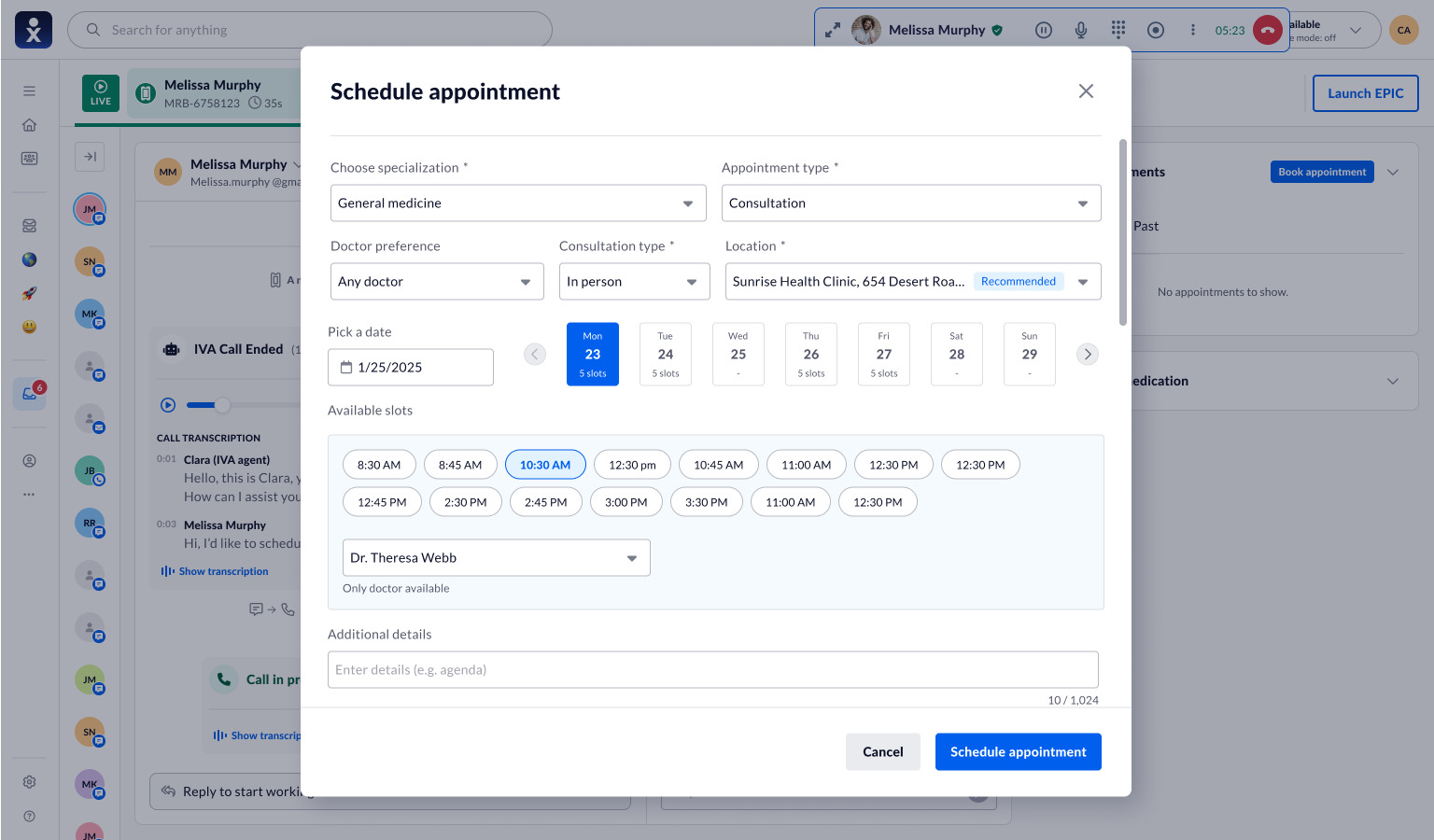
V1 · Schedule appointmentV1 manual schedule-appointment modal covering the live call
The first draft was a manual form. Specialization, type, provider, location, date, time, agenda — every field, every booking, typed over a live call.
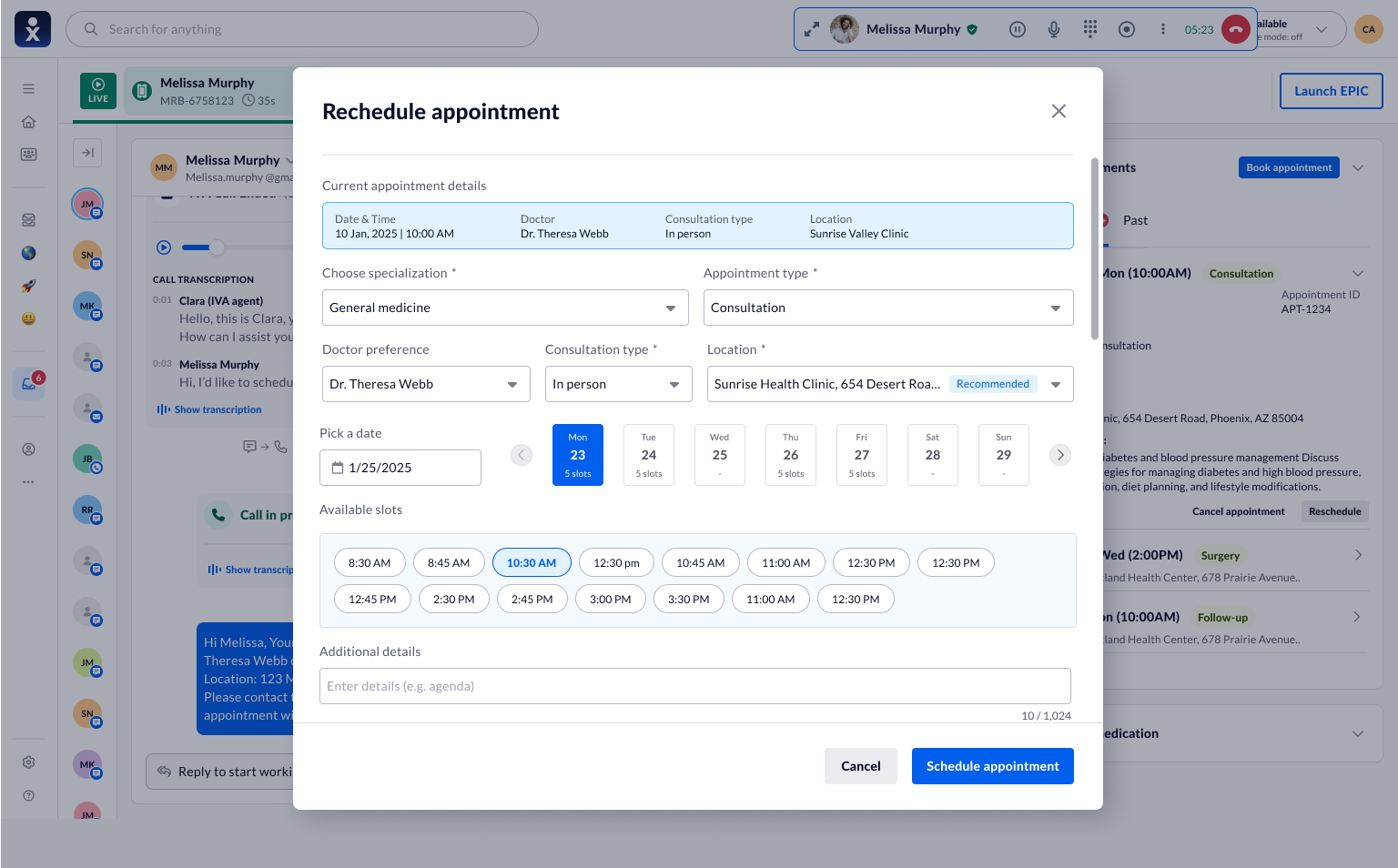
V1 · Reschedule appointmentV1 manual reschedule modal opening over the transcript
Rescheduling reopened the same long form on top of the transcript — burying the conversation the agent was holding mid-sentence.
Key findings
“Not usable as is.” Dispositioning felt tedious and HIPAA-risky; the verification modals blocked the flow.
Scheduling feedback
The three-panel view and ticket info weren’t relevant to scheduling; insurance and a name search were missing.
What was missing
A real practitioner calendar, changeable appointment lengths, and a condensed verification step.
The canvas
Too call-centered: appointments, insurance and billing needed to be visible, not hidden behind widgets.
Heard
“The scheduler is too call-center-like it lacks patient context.”
Shipped
The copilot leads with an identified, verified patient card.
Heard
“Filling the whole form for every booking is a blocker.”
Shipped
Intent + entities pre-fill the booking; the agent just confirms.
Heard
“Availability is buried I read a grid out loud.”
Shipped
Ranked slot cards with a best-match flag, tappable inline.
04 / SolutionOne copilot, three use cases

An AI copilot that does the manual work starting with appointments.

Instead of a form over the call, NextIQ listens to the live transcript, detects what the patient needs, and drafts the action. One model spans three jobs; this case study follows the first one to ship.

This study
Appointments
Schedule, reschedule and cancel intent detected, real slots ranked, booked in one confirm.
Same model
Bills pay
Surface the balance and due date in-call, then take payment without a separate portal.
Same model
Prescriptions
Refill and renewal, routed to the provider for review and sent to the patient’s pharmacy.
05 / Why it was hardSystem, not a screen

This wasn't a UI redesign. It was six live systems resolving in seconds.

Every layer had to stay legible to a human under time pressure — and every layer could be wrong. Design had to make the chain inspectable at a glance.

Patient & agent
A live, non-linear conversation patients backtrack and change their minds
input · realtime
AI layer
Transcribes, classifies intent, extracts entities, scores its own confidence
model
Healthcare context
Patient record, insurance, provider relationships, prior visits, eligibility
PHI · HIPAA
Recommendations
Ranked appointment slots matched to specialty, provider, time & location preference
ranked
Agent action
The human reviews, adjusts, and confirms the one irreversible step
human-in-loop
Follow-ups
SMS reminders, clinical notes, downstream tasks fire automatically
automations
Every follow-up feeds the next call's context the loop never fully closes.
06 / ExplorationFive places the AI could live

Before the panel, five directions — and why four failed.

Each concept solved the previous one's worst flaw and introduced its own. The final design isn't a winner; it's an inheritance. See full exploration in live case study review →

01 · Floating assistantRejected
Out of sight, out of mind. Time-sensitive guidance hidden behind a click the agent might never notice.
02 · Step wizardRejected
Conversations aren't linear. The modal covered the transcript and forced patients into a script they kept breaking.
03 · Activity timelineEvolved
Right shape, read-only. A persistent side feed worked but it narrated the past instead of letting the agent act.
04 · Chat assistantEvolved
Great voice, buried actions. Explainable and collaborative but slots dissolved into prose the agent had to re-parse.
05 · Embedded panelShipped
The synthesis. Persistent like the timeline, conversational like chat — but every event is a structured, tappable action card.
07 / DecisionsDecision · Evidence · Outcome

Seven decisions that shaped the product.

Not a tour of screens a record of trade-offs. Each decision below traces from an observed failure to the shipped behavior it produced.
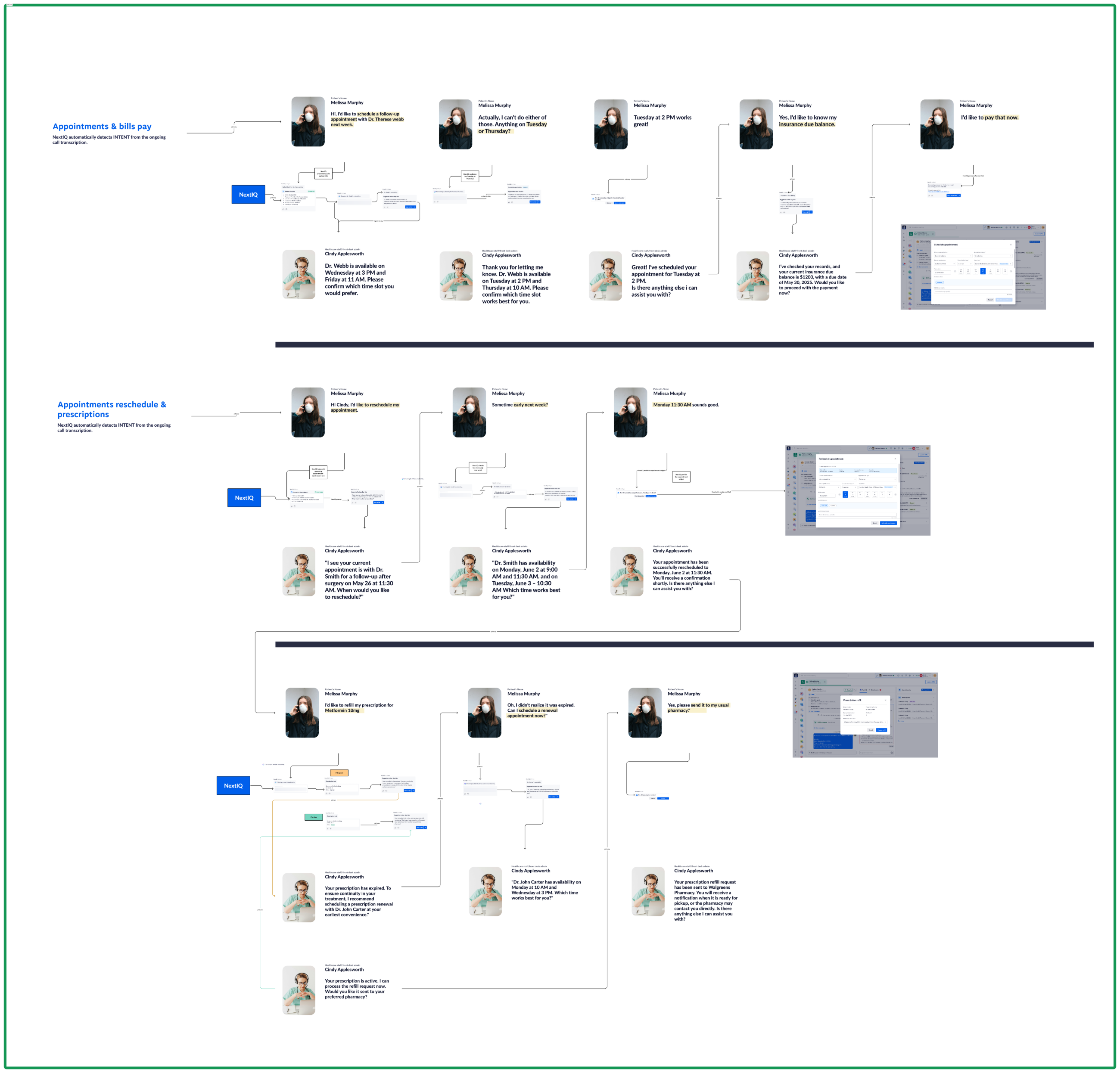
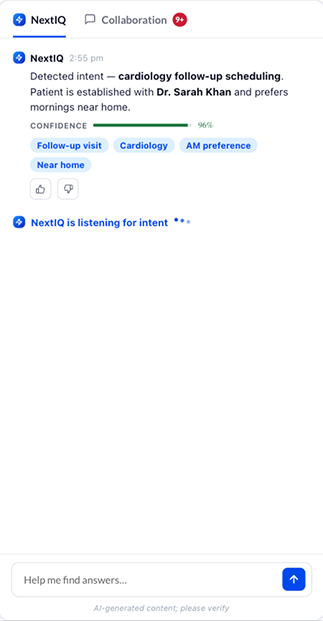
conversation-flows · figjam
Full conversation-flow map covering appointments, reschedule, bills pay and prescriptions
Before any panel, the conversation. Every branch — appointments, reschedule, bills pay, prescriptions — mapped end to end, patient line by patient line, to find where NextIQ should speak and where it must stay silent.
Early NextIQ panel concept — a suggested action with edited copy and a confirm-and-schedule control
The panel fell out of the flows
Mapping the dialogue surfaced the real unit of design: a suggested action the agent reads, edits, and confirms. The strikethroughs are the script tightening in place — the seed of the typed-card model.
08 / AI UXWhat makes AI products different

Six challenges no SaaS playbook covers.

Designing for a probabilistic system in a clinical setting raised problems that don't exist in deterministic software. Each one left a visible mark on the shipped product.

Trust
Agents won't repeat an AI suggestion to a patient they can't defend out loud. Trust is earned per interaction, never assumed.
Design move: AI proposes, the human confirms — every booking is one deliberate click, and nothing ever fires silently.
Transparency
A recommendation without a "why" gets ignored or overridden. The reasoning had to be visible without becoming homework.
Design move: Every suggestion carries its evidence — intent chips, confidence bar, and the transcript moment that triggered it.
Context memory
Patients backtrack and change their minds mid-call. The AI's current belief had to stay inspectable and correctable.
Design move: Entity chips show what the model currently believes; any chip can be tapped to override it on the spot.
Prompt discoverability
A blank input box is a dead feature. Agents under call pressure won't invent prompts — capability has to surface itself.
Design move: The panel leads with state-aware suggested actions; the free-form composer is a fallback, not the front door.
AI confidence
A raw percentage is meaningless without consequences. 96% of what? Confidence needed a behavioral contract.
Design move: The four-tier policy binds score to behavior — pre-fill, suggest, offer, or escalate. Agents learn the contract once.
Medical safety
A wrong restaurant suggestion is a shrug. A wrong specialty referral is a harm event in a HIPAA-conscious environment.
Design move: Clinical topics hard-route to escalation regardless of confidence. The AI schedules; it never advises.
09 / ShippedThe final experience

One panel. Four states. The full call lifecycle.

Every element below exists because an earlier version failed without it. The annotations trace each one back to its decision.
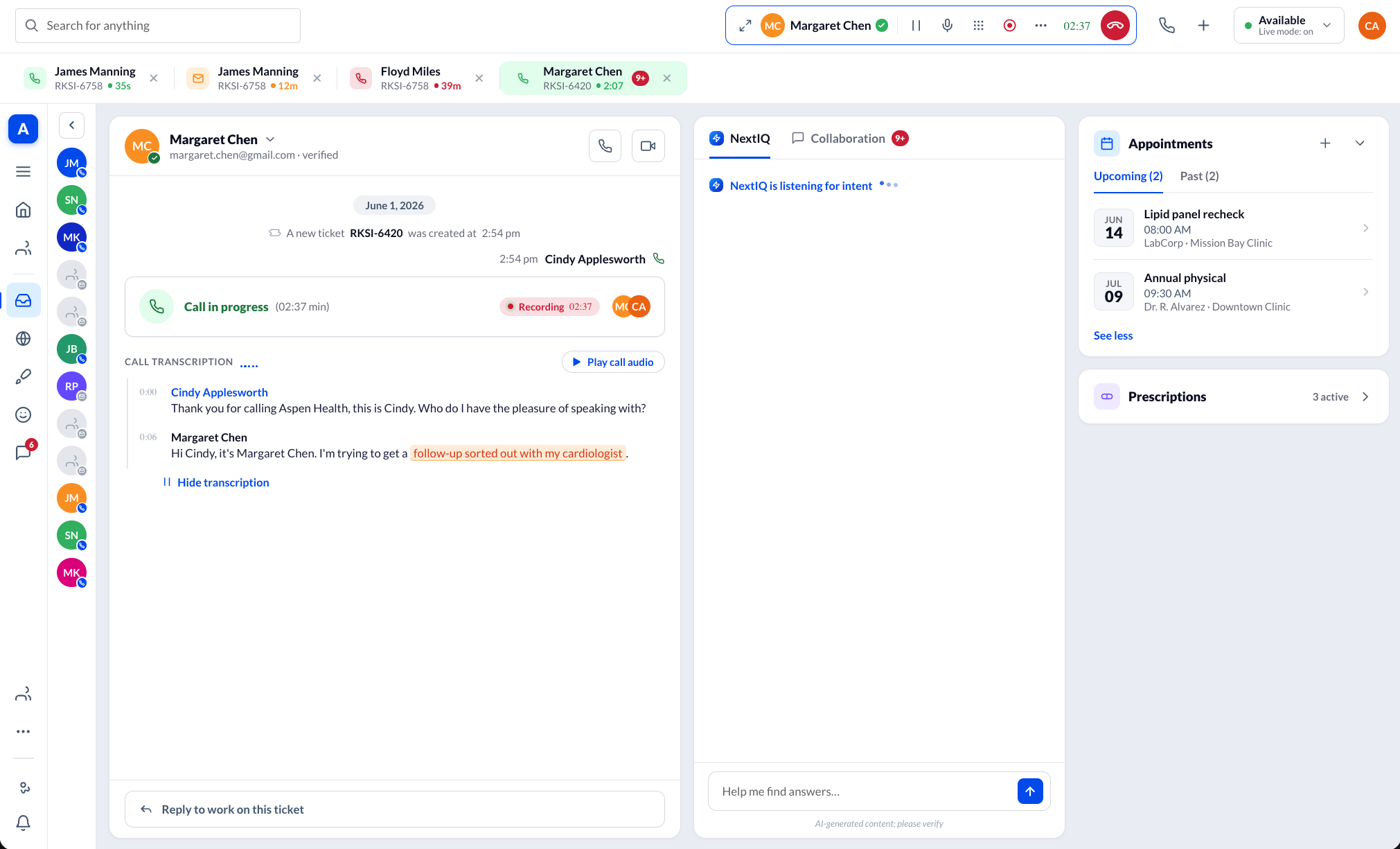
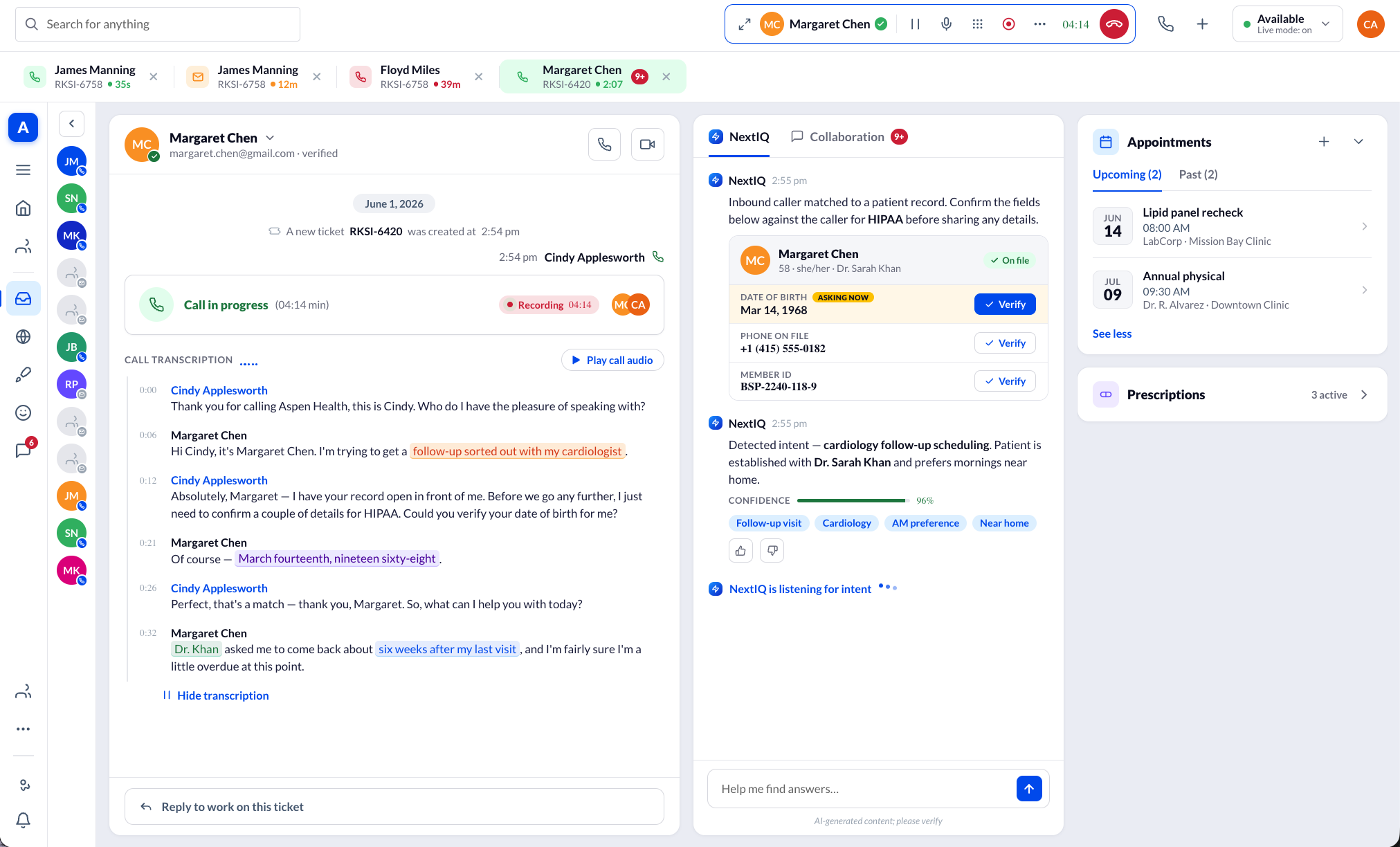
The full call lifecycle, end to end — watch the copilot move from listening to a confirmed booking.
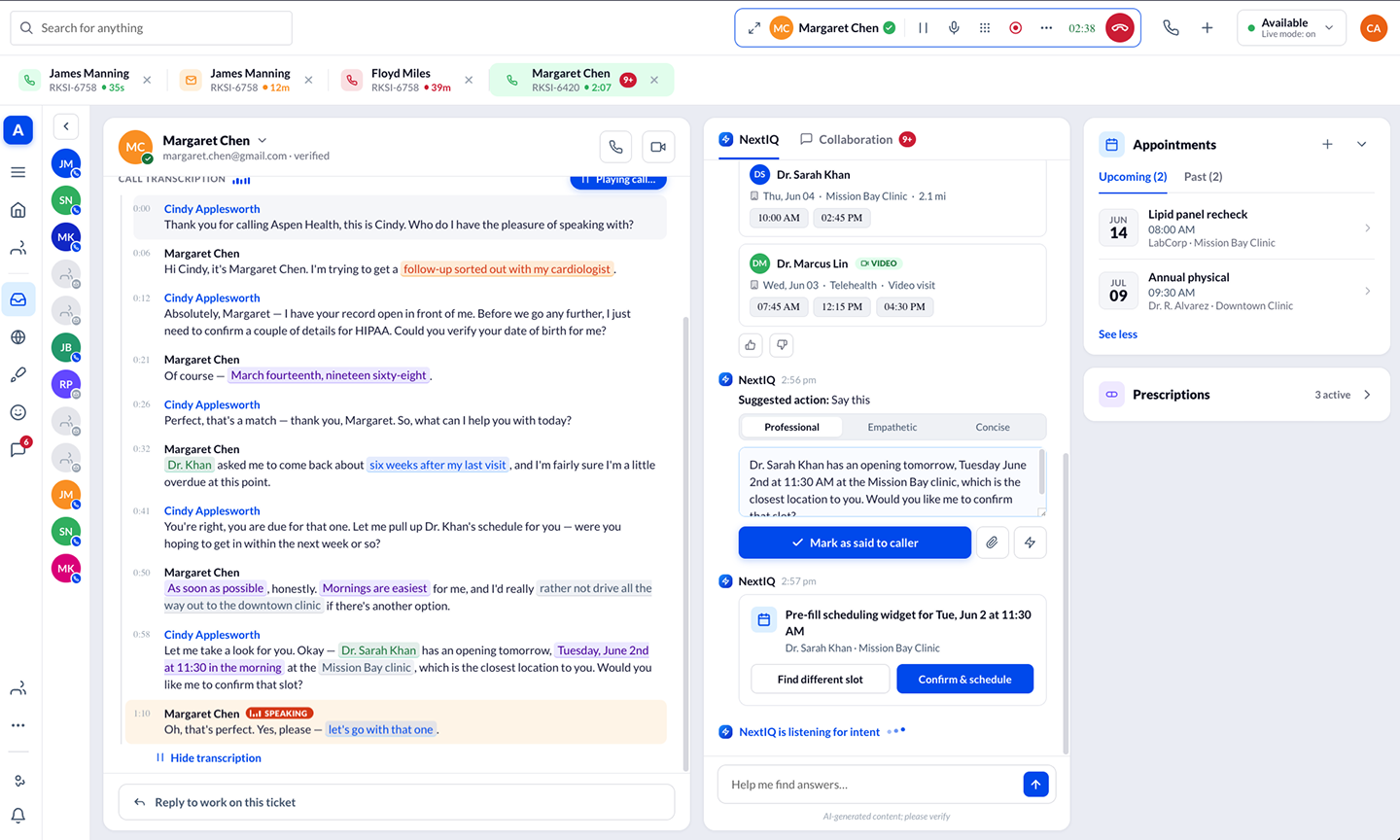
Scheduling state — intent detected, slots surfaced beside the live call
1
The call stays the hero
Live transcript with entity highlights on the left — the panel never covers or competes with it. Inherited from the wizard's failure.
2
Structured cards, conversational voice
Intent chips, a confidence bar, and tappable slot cards in one prioritized column. Chat's tone, the timeline's persistence.
3
Patient context on the right rail
Appointments and prescriptions sit one glance away — the data agents used to dig through three systems to find.
4
Composer as fallback, not front door
"Help me find answers…" handles the long tail. The default path is suggested actions, so capability surfaces itself.
State 1 — Listening
STATE 01
Listening
Transcription starts. Zero UI noise.
State 2 — Intent detected
STATE 02
Intent detected
Call type classified, entities extracted. 96% · auto.
State 3 — Scheduling
STATE 03
Scheduling
Matched slots surface. Human-in-loop · 1 click.
State 4 — Confirmed
STATE 04
Confirmed
Booking fires, four automations run in parallel.
Confirmed state — appointment booked, call ended clean
5
One deliberate click books
The confirm is the single irreversible act, and it always belongs to the human. The trust bet, kept.
6
Automations fire downstream
SMS reminder, clinical note, calendar entry, and follow-up task run in parallel — visible, so the agent ends the call clean.
7
The feed is the audit trail
Every AI action stays in the chronological feed — inspectable after the call, which is what made compliance comfortable.
10 / ImpactWhat moved

Manual work, removed from the call.

58%
Reduction in average handle time on AI-assisted bookings
12 1
Manual scheduler fields collapsed to a single confirm
96%
Intent-classification confidence on the scheduling flow
Proven results in healthcare
Impact
20%
Improved Answer Ratios
NEBA Health
Improved answer ratios by 20% with Nextiva Contact Center for better patient care.
Impact
50%+
Phone Cost Savings
Mountains Community Hospital
Cut phone costs by more than half with HIPAA-compliant communications.
Impact
93%
Recruiting Goals Met
Ontrak Health
Hit patient recruiting goals on 93% of business days with Nextiva.
Impact
500+
Employees Connected
Horizon Health
Unified communications across 22+ behavioral health locations.

User impact

  • Zero context switchesIntent → slot → confirm without leaving the call view
  • Faster task completionMinutes of cross-system searching collapsed into seconds
  • AI that surfaces itselfState-aware suggestions replaced the blank-box problem

Product impact

  • Adoption, not mandateAgents chose the copilot because it was faster than working around it
  • Fewer overridesLegible confidence cut second-guessing of correct suggestions
  • A platform, not a featureRefill and billing flows shipped on the same panel model

Team impact

  • Shared card librarySix typed cards became a design-system pattern other teams reuse
  • Faster iterationThe state contract let design and AI eng work in parallel
  • Aligned vocabulary"Act, suggest, offer, escalate" became how the whole team reasons about AI behavior
11 / ReflectionWhat I'd build in V2

The shipped product is the floor, not the ceiling.

Not lessons learned a roadmap. Four investments I'd argue for next, in priority order.

V2—01
Long-term patient memory
The rolling context window resets every call. Cross-call memory last visit, standing preferences, open follow-ups — would let the copilot start each call already oriented, instead of re-learning the patient live.
V2—02
Proactive healthcare workflows
Today the AI reacts to intent. The data already knows who's overdue for a follow-up or out of refills the next step is the copilot opening the call with the work pre-staged, before the patient asks.
V2—03
Per-agent personalization
Tone defaults, suggestion density, and confirm friction are global today. Agents differ a five-year veteran and a first-week hire shouldn't get the same level of hand-holding from the panel.
V2—04
Explainability beyond the score
The confidence bar says how sure; it doesn't say why. An evidence trace —the transcript moments that drove the classification — would turn the bar from a claim into an argument.
CloseAppointments was the first to ship

The walkthrough is best as a conversation.

This study follows scheduling end-to-end; bills pay and prescriptions run on the same copilot model. The working prototypes and the deeper write-up are below.

The complete end-to-end walkthrough research depth, exploration, and design rationale is reserved for a full live interview presentation.
Explore the working prototypes